


The Connected Services Framework (CSF) is an industry-led standard that simplifies switching between business communications providers, ensuring the process is straightforward, consistent, secure, and compliant.

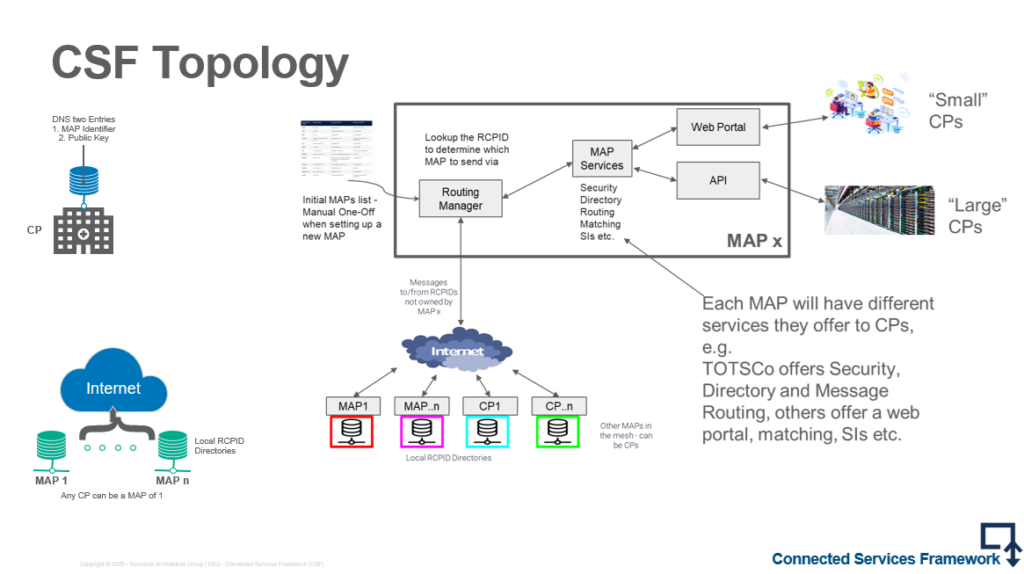
Unlike costly alternatives, CSF can be hosted directly by a communications provider (CP) or through a Managed Access Provider (MAP). It provides a common approach that reduces complexity while remaining flexible enough to meet both industry-wide and individual provider requirements.

Developed by the Technical Architecture Group (TAG)—a collaboration of leading telecom platform providers—CSF v1.0 focuses on business switching, with plans to expand into number porting, wholesale ordering, and outage notifications.


About CSF

The Connected Services Framework (CSF) is an open, industry-led initiative that standardises communication between telecom providers across the UK.

Why CSF Matters

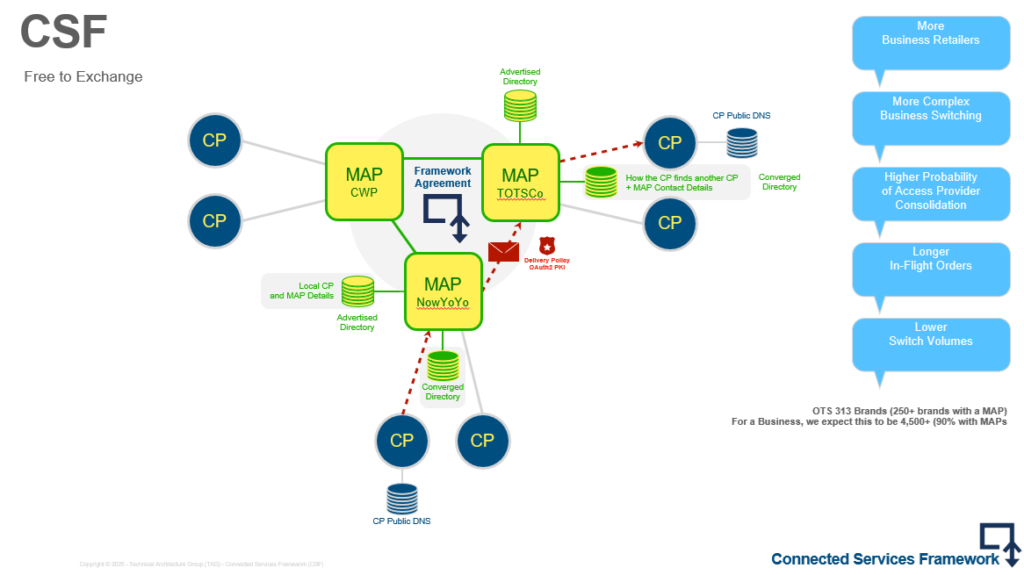
Under Ofcom’s General Conditions (C7 – Switching), business service providers must manage switching when customers move to them. Unlike consumer switching (OTS), which is centrally coordinated, business switching has no single system—leaving over 4,500+ providers to manage processes individually.

This leads to:

CSF solves this by providing a common, standards-based method for transmitting switching messages. This:

Who is involved

The TAG group (active since April 2024) is driving CSF development. Current members include:

CSF MemberWebsiteContactServices to multiple CPs
NowYoYonowyoyo.comsales@nyy.globalYes
iconectiviconectiv.combfabrykant@iconectiv.comYes
CWPcwpuk.orgmemberships@cwpuk.orgYes
ICUKicuk.netsales@icuk.netYes
The Communications Gatewaycomgw.ukchris@comgw.co.ukYes

Future members could include MAPs offering managed GPLB services and CPs looking to automate intra-CP communications through CSF.


Overview

The CSF standard that was been created incorporates many improvements over the current transport of the OTS messages (via TOTSCo).

Key standard definitions that have been incorporated are: 

The latest CSF is published in to parts. CSF v2.0.2 – Part 1 (published below) covers the CSF definition and CSF – Part 2 will cover the implementation of the CSF (to be published soon and as such CSF v1.0 is stil current where it concerns imlmentation matters).

Please download the current CSF standard here: 


News 


Join CSF

Membership Process

Any MAP or CP can join CSF by:

  1. Implementing the CSF standard in their systems.
  2. Completing sponsorship testing, where an existing member validates the new API connection and messaging.
    • Sponsorship operates on a cost-recovery basis.

Governance

CSF Governance — At a Glance
Connected Services Framework · Part 1, Chapter 10 GOVERNANCE AT A GLANCE · v1.1 · 04 · 2026

How CSF Governance works, as the TAG now operates.

A one-page summary of the standards landscape, the TAG’s change process, and the nine governance controls ratified by the steering group on 29 April 2026.

At a glance
The CSF is an open technical standard maintained by the TAG, sitting on top of standards held by OTA2, TOTSCo, and GPLB-SG.
Governance is decentralised by design — the §10.6 controls strengthen it without adding heavy administration.
· The standards landscape · what feeds the CSF
OTA2
Office of the Telecommunications Adjudicator
  • RCPID Standards
  • JAM Specification
→ message format & addressing
TOTSCo
Telecoms One Touch Switching Company
  • OTS Process & Message Specs
  • Transport Delivery Policy — 9xxx
  • Hub API Specification
→ OTS compatibility & error codes
GPLB-SG
Switching for Business Steering Group
  • SfB Process documentation
  • Matching & Validation Specs
→ business process & content
feeds
CSF Standards
TAG
Telecom Technical Architecture Group
  • CSF Framework & Implementation
  • Transport Policy — 8xxx
  • Onboarding & Testing
↺ weekly steering group
· How the CSF changes ·

Five steps, one weekly forum.

1
Proposal. Any TAG member can propose a change.
2
Review. The steering group reviews it at its weekly meeting.
3
Consensus. Changes require consensus among TAG members.
4
Publication. Approved changes are published and versioned.
5
Adoption. MAPs adopt incrementally through API versioning.
Decentralised by design. No central administrator; controls are distributed to MAPs and CPs. Self-regulation through DNS, PKI, and directory transparency.
RATIFIED · §10.6 Nine governance controls — adopted 29 Apr 2026
Strengthening the model without heavy administration.
10.6.1
Decision-making & voting
60% quorum; one MAP, one vote; simple/super-majority.
10.6.2
MAP compliance & periodic review
Annual self-certification and lightweight peer review.
10.6.3
Version adoption policy
Six-month support window; three months’ deprecation notice.
10.6.4
Dispute resolution
Three tiers: direct → TAG mediation → OTA2 (binding).
10.6.5
Incident response
Security contacts; 72-hour GDPR-aligned breach notice.
10.6.6
MAP suspension & removal
Warning → probation → suspension → removal, with CP continuity.
10.6.7
Anti-competitive safeguards
No exclusion, no preferential routing, no info misuse.
10.6.8
CP representation
CP feedback channel and a plain-language Rights Charter.
10.6.9
Documentation & transparency
Public spec, change log, archived versions retained.
· The cadence · weekly TAG, annual review
The TAG steering group meets weekly; MAPs self-certify annually; new versions carry a six-month minimum support window with three months’ deprecation notice — and disputes get five working days at Tier 1 before escalating to TAG mediation.
The TAG ratified the nine §10.6 controls on 29 April 2026; they are now the operational baseline.
© 2026 Connected Services Framework
Maintained by TAG · v1.1 · 29 Apr 2026

Benefits of Membership


Contact

📧 Email: info@csf-uk.org
📍 Address: 7 Bell Yard, London, WC2A 2JR
📞 Phone: (+44) 020 3051 3453

Name

Member Portal

If you are a CSF member, you can access shared documents and resources via the link below.